
St Paul shipwreck Malta: Did It Happen at St Thomas’ Bay Instead of St Paul’s Island?
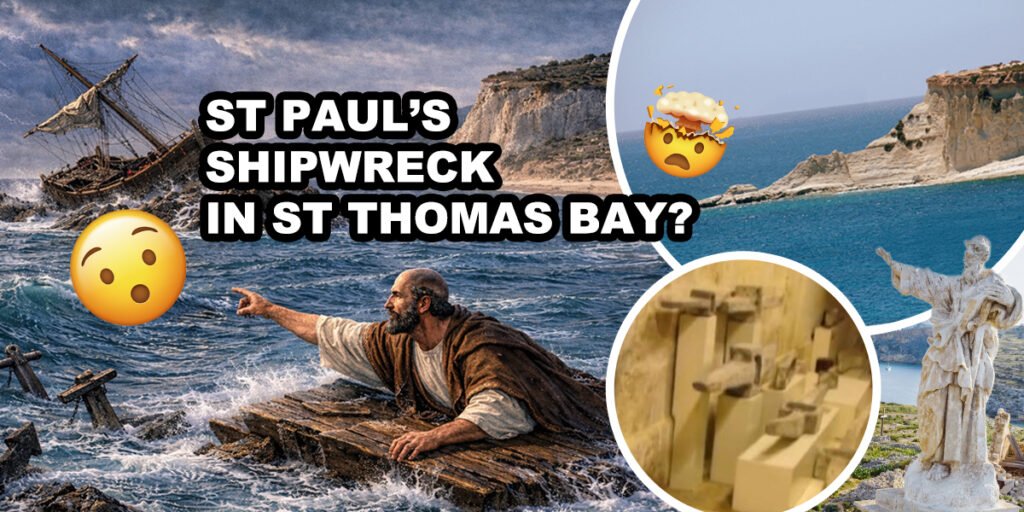
Introduction – St Paul shipwreck Malta: Did It Happen at St Thomas’ Bay Instead of St Paul’s Island?
One of Malta’s most enduring and fascinating historical mysteries is the shipwreck of the Apostle Paul. Described in the New Testament in the Acts of the Apostles, the event has shaped Maltese religious identity, culture, and heritage for centuries.
According to tradition, Paul was shipwrecked in the north of Malta, near what is today known as St Paul’s Bay and St Paul’s Island. This belief has been passed down through generations, reinforced by churches, feast days, monuments, and national storytelling.
However, in recent decades, a growing debate has emerged among researchers, historians, and maritime investigators. Some argue that the traditional location may not fully match the biblical description. Instead, they suggest that St Thomas’ Bay, on Malta’s south-eastern coast near Marsaskala and Munxar Reef, fits the details of the account far more closely.
This article explores both perspectives in depth. We examine the biblical narrative, the traditional belief, the alternative St Thomas’ Bay theory, the archaeological and nautical evidence, and the criticisms surrounding each position. The goal is not to replace tradition, but to understand whether history may be more complex than commonly believed.
Watch this short clip below by CBN News before commenting:
By Bob Cornuke
Robert Cornuke is an American writer and president of the Bible Archaeology Search and Exploration Institute (BASE), which is operated from his home in Colorado Springs, Colorado. He describes himself as a Biblical archaeologist, but has no degree or training in archaeology.
The Biblical Account of Paul’s Shipwreck
The shipwreck of St Paul is described in Acts chapters 27 and 28. Paul, a prisoner under Roman guard, was being transported by ship from Caesarea to Rome. During the journey, the vessel encountered a powerful Mediterranean storm that lasted many days.
Key details from the biblical text include:
-
The ship was driven helplessly by violent winds.
-
Cargo and equipment were thrown overboard to lighten the ship.
-
After many days without sun or stars, the crew lost hope.
-
Sailors took soundings and discovered decreasing depth.
-
Four anchors were dropped from the stern to prevent the ship from crashing.
-
At daylight, the sailors saw a bay with a beach and attempted to run the ship aground.
-
The ship struck a place where two bodies of water met and broke apart.
-
All 276 people aboard survived by swimming or floating to shore.
-
The island was identified as Melita, widely accepted as Malta.
Several of these details are highly specific and form the foundation of the ongoing debate about the exact location of the shipwreck.
The Traditional Location: St Paul’s Bay and St Paul’s Island
How the Tradition Began
For centuries, Maltese tradition has identified St Paul’s Bay and the small island just offshore as the site of the shipwreck. This belief dates back to early Christian times and became firmly established during the medieval period.
Churches dedicated to St Paul, religious art, pilgrimage routes, and feast celebrations all reinforced this association. Over time, the northern location became deeply embedded in Maltese identity and tourism.
Today, St Paul’s Bay and St Paul’s Island are among the most visited religious and historical sites in Malta. The narrative is widely taught in schools and presented as fact in many guidebooks.
Strengths of the Traditional View
The traditional location is supported by:
-
Centuries of continuous belief and devotion.
-
Strong ecclesiastical tradition.
-
Cultural continuity and national identity.
-
Geographic plausibility within Malta.
For many, these factors alone are sufficient. Tradition, after all, is a powerful historical force.
Challenges to the Traditional View
Despite its importance, the traditional site faces several challenges when examined through a purely analytical lens:
-
Limited archaeological evidence directly linked to a first-century shipwreck.
-
Difficulty matching some biblical details to the geography of St Paul’s Bay.
-
Lack of confirmed anchors or ship remains corresponding to the Acts account.
These issues have led some researchers to revisit the biblical text and reconsider alternative locations.
The Alternative Theory: St Thomas’ Bay and Munxar Reef
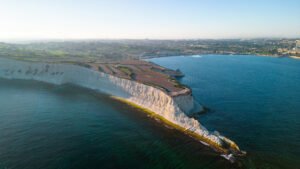
Why St Thomas’ Bay Is Being Considered
St Thomas’ Bay lies on the south-eastern coast of Malta, close to Marsaskala. Researchers who support this theory argue that the bay and nearby Munxar Reef align closely with the specific descriptions in Acts.
The main points in favour include:
-
A clearly defined bay with a natural beach.
-
Nearby underwater reef formations.
-
Historical reports of ancient anchors found offshore.
-
Nautical conditions consistent with a drifting ship during a north-easterly storm.
Supporters argue that when the biblical account is treated like a maritime incident report rather than a symbolic story, St Thomas’ Bay emerges as a strong candidate.
The Anchor Evidence
One of the most frequently cited arguments for St Thomas’ Bay is the discovery of ancient anchors near Munxar Reef.
Local divers reported finding multiple large stone and wooden anchors at depths consistent with the soundings described in Acts. Notably, the biblical account mentions four anchors dropped from the stern, an unusual but specific detail.
While these anchors are generally dated to the Roman period, critics point out that dating anchors precisely is difficult. Without inscriptions or direct ship remains, it is impossible to confirm that they belonged to Paul’s vessel.
Still, proponents argue that the number, size, and location of the anchors deserve serious consideration rather than dismissal.

The “Place Where Two Seas Meet”
Acts describes the ship striking a place where two bodies of water met. This phrase has been the subject of extensive debate.
Supporters of the St Thomas’ Bay theory interpret this as a reference to underwater currents or intersecting wave patterns around Munxar Reef. The reef creates complex sea movement that could explain the ship becoming stuck and breaking apart.
Critics counter that the phrase may simply describe a sandbar, shoal, or narrow channel rather than a reef. They argue that similar conditions could exist elsewhere around the island.
The ambiguity of the original Greek text means that this clue cannot be considered definitive on its own.
Sailors Not Recognising the Land
Another intriguing detail in Acts is that the sailors did not recognise the land when daylight came.
Those who favour St Thomas’ Bay suggest that the south-eastern coastline may have appeared unfamiliar to sailors approaching from the open sea during a storm, especially if visibility was poor or landmarks were obscured.
Opponents argue that Malta was well known to Mediterranean sailors during Roman times and that major harbours in the south would likely have been recognisable.
This point remains contested and highlights how interpretation plays a major role in the debate.
Nautical and Weather Considerations
Maritime researchers supporting the southern theory often reference wind patterns and sea currents.
A strong north-easterly storm, consistent with descriptions in Acts, could plausibly drive a ship toward the south-eastern coast of Malta. St Thomas’ Bay sits directly in the path such a storm might push a drifting vessel.
Critics respond that ships could be driven toward many parts of Malta under similar conditions. Weather alone cannot pinpoint an exact landing site.
Scholarly Criticism and Counterarguments
Several historians and biblical scholars have criticised the St Thomas’ Bay theory.
Common criticisms include:
-
Selective interpretation of evidence.
-
Overreliance on unverified anchor reports.
-
Underestimating the importance of long-standing tradition.
-
Misinterpretation of ancient nautical practices.
Some scholars argue that alternative theories often underestimate how symbolic and theological the Acts narrative may be, rather than strictly technical.
Others caution against replacing one unproven location with another without conclusive archaeological proof.
Tradition Versus Evidence
At the heart of this debate lies a broader question. How should history balance tradition and evidence?
Tradition preserves memory, identity, and continuity. Evidence challenges assumptions and invites deeper understanding. In the case of Paul’s shipwreck, both play an important role.
The traditional location at St Paul’s Bay remains culturally and spiritually significant regardless of academic debate. Meanwhile, St Thomas’ Bay offers an opportunity to re-examine history through a different lens.
Importantly, acknowledging an alternative theory does not erase tradition. It enriches the story and keeps historical inquiry alive.
Why This Debate Matters to Marsaskala and the South
For Marsaskala and surrounding areas, the discussion holds particular significance.
If St Thomas’ Bay played a role in one of Christianity’s most famous maritime events, it would add a profound layer of historical importance to the region. It could reshape local heritage interpretation, tourism narratives, and archaeological interest.
Even if the theory remains unproven, the debate itself highlights the depth of Malta’s coastal history and the importance of preserving and studying lesser-known sites.
Frequently Asked Questions
Does the Bible clearly state where Paul shipwrecked?
No. The Bible names the island as Melita but does not specify a precise modern location.
Has definitive proof been found?
No. No archaeological evidence has conclusively identified the exact shipwreck site.
Why is St Paul’s Bay still widely accepted?
Because of centuries of tradition, religious devotion, and cultural continuity.
Could the shipwreck have happened elsewhere?
Some fringe theories suggest other Mediterranean locations, but most scholars agree the event occurred in Malta.
Conclusion
The question of where St Paul shipwrecked remains open.
St Paul’s Bay and St Paul’s Island continue to hold immense cultural and spiritual importance for Malta. At the same time, St Thomas’ Bay and Munxar Reef present compelling geographical and nautical arguments that invite further study.
Rather than viewing this as a conflict, it can be seen as an opportunity. An opportunity to explore Malta’s history more deeply, to question respectfully, and to appreciate how faith, tradition, and evidence intersect.
History is not always fixed. Sometimes, it is rediscovered.
